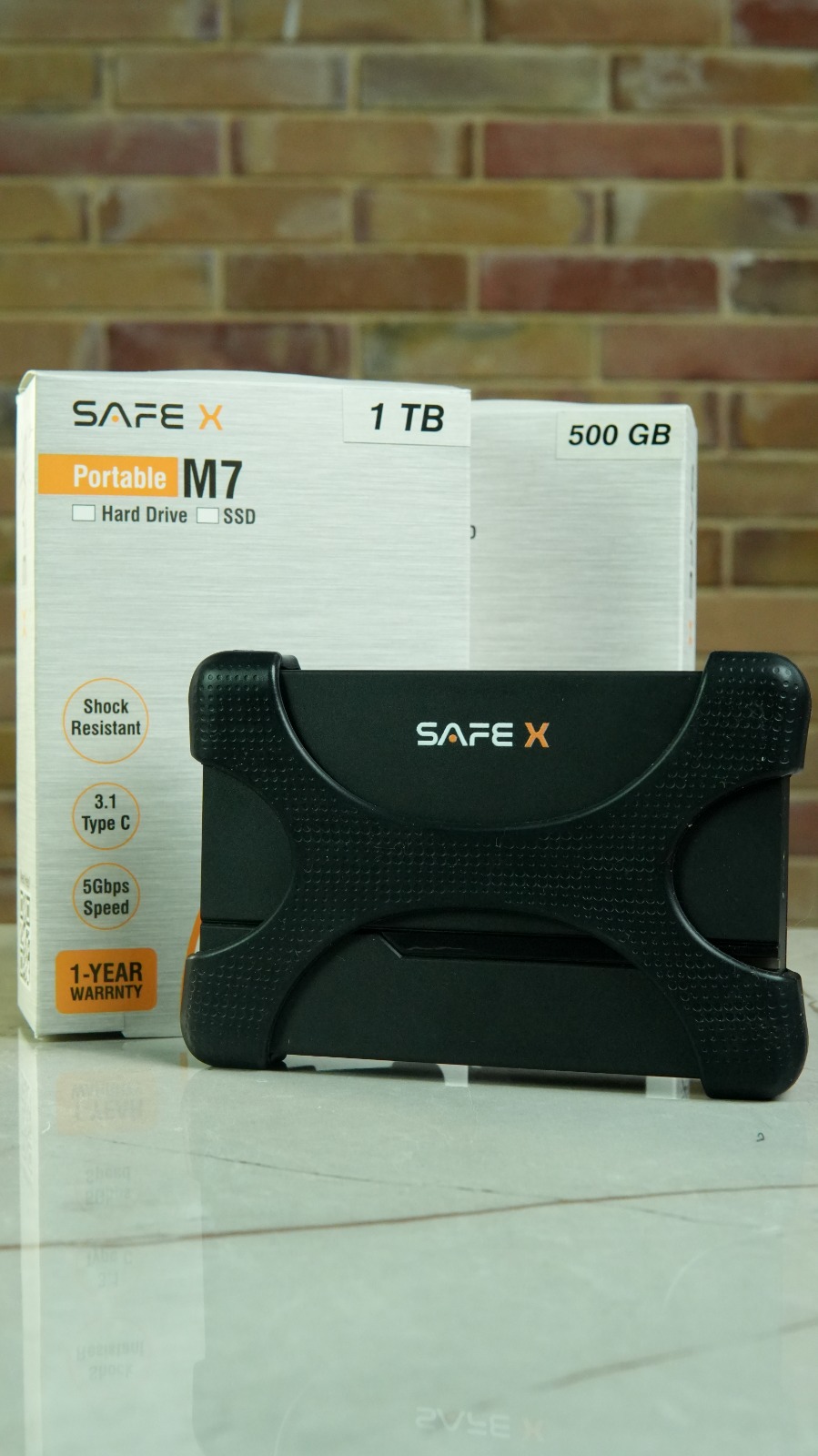
Safe-X M7 SATA3 Solid State Drive
₨ 6,666
The Safe-X M7 is a high-performance SSD based on NAND Flash technology, specifically engineered to eliminate computing bottlenecks by replacing traditional hard disk drives. Featuring a 2.5-inch form factor and a SATA III interface, it offers sequential read speeds up to 550MB/s and write speeds up to 470MB/s. With its rugged, semiconductor-based design and no moving parts, it provides superior reliability and silent operation for both industrial and consumer systems.
Free shipping on orders over $50!
- Satisfaction Guaranteed
- No Hassle Refunds
- Secure Payments
Description
Safe-X SATA SSD (Solid State Drive) is a high performance and high reliability storage device
based on NAND Flash technology that designed to solve the bottleneck of computing system by
traditional hard disk drives. Our SATA SSD doesn’t have a moving parts and it has a same host
interface and same physical dimension with Hard Disk Drive, so it can be drop-in replaced with the
hard disk drives without any problem. With a high performance and low power consumption, Our
SATA SSD can be a good storage device for NB and Tabletop PC.
Safe-X SATA SSD purely consists of semiconductor devices and NAND flash memories, which give
rugged features against shock and vibration, used in extreme environment such as industrial PC to
increase MTBF. Furthermore, Our SATA SSD has highly advanced flash memory management
algorithm to guarantee
- I. Product Introduction & Overview
The Safe-X SATA SSD is a high-performance, high-reliability storage device based on NAND Flash technology. It is engineered to:Eliminate Bottlenecks: Designed to solve the computing system bottlenecks caused by traditional hard disk drives.
Drop-in Replacement: It features the same host interface and physical dimensions as a standard HDD, allowing for seamless replacement.
Rugged Reliability: Consisting purely of semiconductor devices, it is resistant to shock and vibration, making it ideal for industrial PCs and extreme environments.
Target Applications: Optimally designed for Notebooks (NB) and Tabletop PCs due to its low power consumption.II. Technical Specifications
Performance & Capacity
Physical & EnvironmentalIII. Reliability & Advanced Features
The drive utilizes the RM1135 controller to manage data integrity and lifespan.ECC Descriptions: Features an LDPC ECC engine that enhances decoding throughput and data reliability.
Wear-Leveling: Implements both Static and Dynamic Wear-Leveling to distribute write cycles evenly across the media, significantly prolonging the device’s lifetime.
S.M.A.R.T. Function: Self-Monitoring, Analysis, and Reporting Technology allows the drive to monitor its own health and report potential problems to prevent unscheduled downtime.
Data Retention: Guaranteed for > 20 years at 25°C.
MTBF: Greater than 2,000,000 hours.
Warranty: 3 years. - IV. Interface & Pin Assignment
The device complies with Serial ATA standard version 3.1. It supports:
Host Transfer Rate: 600MB/s (6.0Gb/s).
Modes: PIO modes 0-4, DMA modes 0-2, and UDMA modes 0-6.
Pin Connector Summary:S1 – S7: 7-Pin Signal Connector (includes differential signal pairs A and B and Ground).
P1 – P15: 15-Pin Power Connector (includes 5V power and Ground; 3.3V and 12V pins are unused).Benchmarking Performance (Test Results)
Testing was conducted on a system with an Intel Core i3-2100T CPU and 4GB RAM.CrystalDiskMark 8.0.4:
Sequential Read: 550.71 MB/s.
Sequential Write: 472.96 MB/s.AS SSD Benchmark:
Sequential Read: 520.64 MB/s.
Sequential Write: 444.69 MB/s.
Access Time (Read): 0.029 ms.Base Specifications
-
Interface: SATA III (6.0 Gb/s).
-
Capacity: 128GB (Available capacity: 119.24GB).
-
Controller: RM1135.
-
Flash Type: 3D TLC NAND Flash.
-
Dimensions: $100 \times 70 \times 7$ mm.
-
Weight: 42g to 45g.
Performance
-
CDM Sequential Read: Up to 550 MB/s.
-
CDM Sequential Write: Up to 470 MB/s.
-
ATTO Sequential Read: Up to 500 MB/s.
-
ATTO Sequential Write: Up to 450 MB/s.
-
Random Read/Write (IOPS): 32,586 / 74,023
Power Consumption
-
Power Supply: 5V ± 5%.
-
Standby Power: 0.3W.
-
Maximum Ripple: 70 mV (peak to peak).
-
4KB Random Write Power: 2.5W.
Reliability & Features
-
Write Endurance: 3 years at 100GB write per day.
-
Read Endurance: Unlimited.
-
MTBF: Greater than 2,000,000 hours.
-
Data Retention: Greater than 20 years at 25°C.
-
ECC: LDPC-based ECC Engine.
-
Wear-Leveling: Static and dynamic wear-leveling algorithms.
-
Management: Supports S.M.A.R.T., NCQ, Trim, and dynamic power management.
-
Protection: Sudden power-off recovery and bad block management.
-
Data Security: Data destroy is not supported.
Environmental & Warranty
-
Operation Temperature: 0°C to 75°C.
-
Storage Temperature: -55°C to 95°C.
-
Humidity: 5% to 95%.
-
Vibration: 15G (10 to 2000Hz).
-
Shock: 350G at 0.5ms.
-
Warranty: 3 years.
Physical Dimensions:
Length: 100+0.1mm
width: 70+0.1mm
height: 7+ 0.1mm
ReliabilityECC Descriptions
The LDPC ECC engine executes parity generation and error detection/correction features, and
enhances decoding throughput and data reliability. With LDPC of correction capacity 1 e-2 RBER,
the hard and soft decoding mechanism provides powerful error correction. Hence the RM11 35 can
enhance the endurance and retention of 3D TLC Nand Flash and extends the SSD lifespan.
5.2 Advance Wear-Leveling Algorithm
The NAND flash devices are limited by a certain number of write cycles. When using a file system,
frequent file table updates is mandatory. If some area on the flash wears out faster than others, it
would significantly reduce the lifetime of the whole device, even if the erase counts of others are far
from the write cycle limit. Thus, if the write cycles can be distributed evenly across the media, the
lifetime of the media can be prolonged significantly. The scheme is achieved both via buffer
management and specific advanced wear leveling to ensure that the lifetime of the flash media can
be increased, and the disk access performance is optimized as well.
5.3 S.M.A.R.T Function
S.M.A.R.T. is an acronym for Self-Monitoring, Analysis and Reporting Technology, an open standard
allowing disk drives to automatically monitor their own health and report potential problems. It
protects the user from unscheduled downtime by monitoring and storing critical drive performance
and calibration parameters. Ideally, this should allow taking proactive actions to prevent impending
drive failure. SMART feature adopts the standard SMART command B0h to read data from the
drive. When the SMART Utility running on the host, it analyzes and reports the disk status to the
host before the device is in critical condition.
-
-
Additional information
| Storage | 128GB, 256GB, 512GB, 1TB |
|---|
Related products
-

Safe-X M6 SATA3 Solid State Drive
₨ 5,555Select options This product has multiple variants. The options may be chosen on the product page
Reviews
There are no reviews yet.